
King and Queen Deed Records by Instrument
The Circuit Court Clerk records more than sales. Some instruments convey an interest. Others secure debt, release a claim, or merely describe the land. Reading a deed index well means knowing which is which. So pair the instrument name with the legal description before drawing any conclusion. King and Queen deed records are never conclusive on a name alone. A name surfaces in an index. When an image is available, open it and read the instrument itself.
| Instrument | Effect in the record | What to check |
|---|---|---|
| Conveyance deed | Transfers the interest stated by the grantor. | Parties, legal description, execution date, and recording date. |
| Quitclaim deed | Transfers whatever interest the grantor holds, without a broad warranty. | Do not infer that the grantor held full title. |
| Deed of trust | Secures repayment through a trustee; it is not an ordinary sale to the lender. | Find a later release or certificate of satisfaction. |
| Release or satisfaction | Records discharge of a lien or secured obligation. | Match it to the original instrument and parcel. |
| Executor or administrator deed | May transfer land under estate authority. | Check the will, qualification, or court order. |
| Plat or easement | Maps lots or records rights affecting land. | Read with the deed’s legal description. |
A conveyance hands ownership down the trail. A deed of trust does something different: it secures a debt. A release shows the debt was discharged. A plat may define lots without moving them, or set easements that no transfer created. When you review deed records, pull the names and instrument type. Grab the recording date too. Note the book and page or instrument number, the parcel reference, and the full description straight from the image.
King and Queen Deed Chain Since 1864
King and Queen County dates to 1691. Its records do not. The Circuit Clerk reports that everything before 1864 was destroyed. The Library of Virginia traces fires in 1828, 1833, and 1864. That history explains why an online index or current deed search stops at the surviving record line. The gap is not a portal error, and the founding date promises no surviving colonial transfers.
Mark what is documented and where proof ends. Wills, chancery orders, tax land books, processioners' reports, church material, and historical-society files can add context around the gap. None is a recovered deed where no conveyance survives. A professional title examiner may resolve older interests that a public index cannot.
The Circuit Clerk's land-record page states the surviving range.
The county notice sets the 1864 date limit, and any deed-chain report should carry that limit forward.
King and Queen Deed Access
King and Queen County routes land-record research through the Clerk, who links Virginia Secure Remote Access as the remote, subscription-based route to land records. In-person inspection and copying remain available at the courthouse. OCRA/CIS is a separate circuit-court system for case information and images, so a court docket search is not the land-record deed index. When a web search fails to surface an image, ask the Clerk which book, index, or counter procedure covers the year in question.
No remote subscription prices, deed-image fees, or certified-copy fees appear on the inspected official pages. Confirm costs with the Clerk before ordering, especially if certification or a specific image format matters. The courthouse directory lists the Circuit Clerk at 234 Allen’s Circle, P.O. Box 67, King and Queen Court House, Virginia, phone (804) 785-5984, open weekdays from 8:30 a.m. to 4:30 p.m.
For remote deed work, Virginia Secure Remote Access is the land-record entry point the local Clerk links.
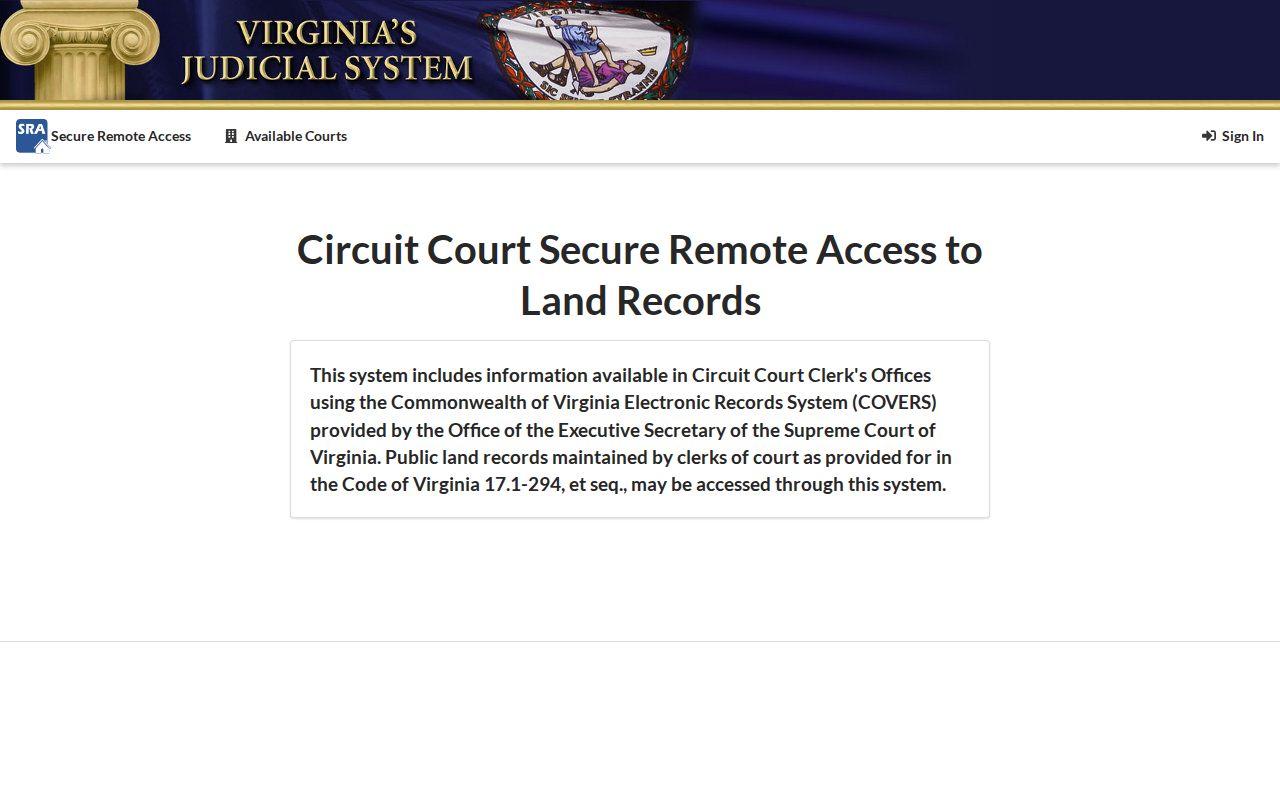
The SRA screen marks a remote route. It does not promise that every book or image is free to view.
VADeed Alert for King and Queen Property
Virginia's VADeed Alert is free. The local Clerk promotes this voluntary sign-up. A registrant matches an owner name or Tax Map/Parcel ID. Notice arrives when recorded activity hits. It is an early warning only. It is not a title search, a fraud block, or a substitute for reading the instrument. An unfamiliar notice calls for the official Circuit Clerk contact. Compare document number, parties, and parcel description.
A match rides on the supplied name or parcel ID. Spelling changes, entity names, and older identifiers can all skew the results. The service still helps an owner watch recorded activity. The authoritative deed image stays in the land-record system. The VADeed Alert sign-in page gives the current enrollment path.
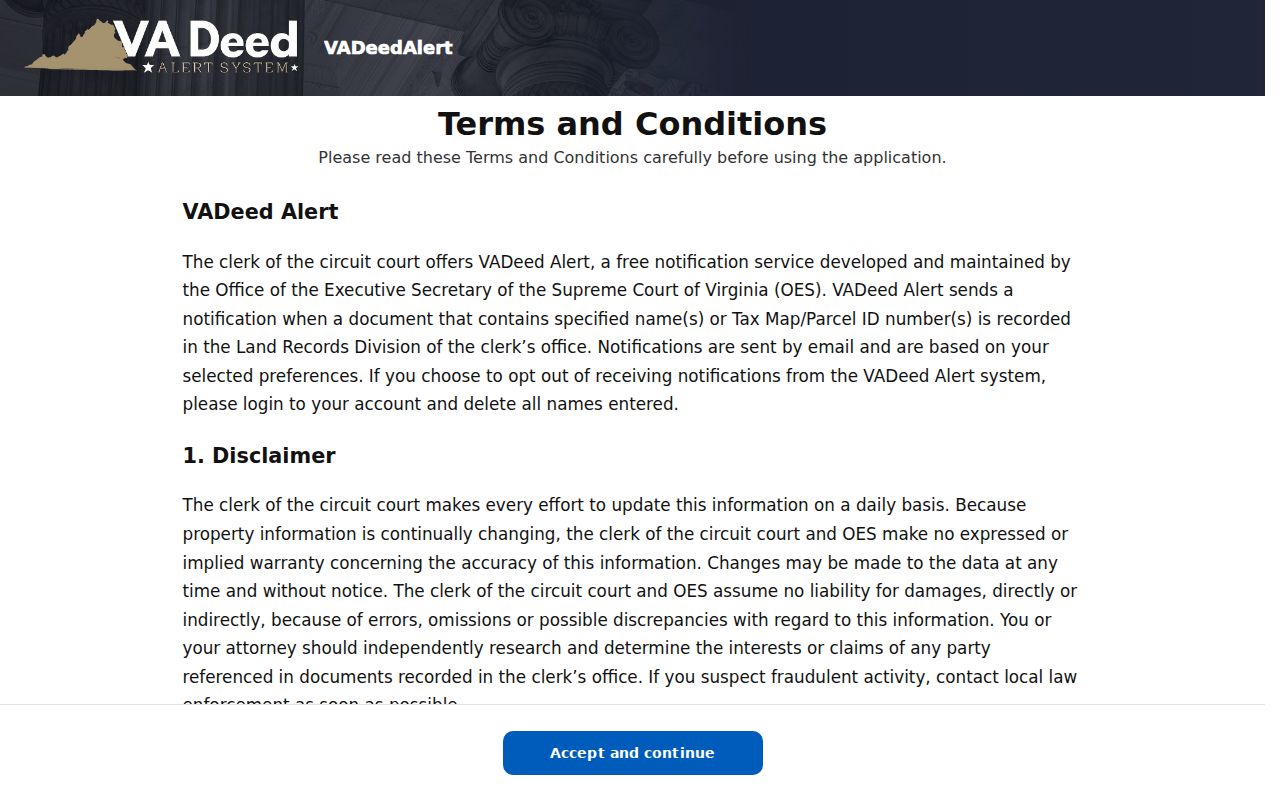
The image shows a portal route, not a deed.
King and Queen Grantor-Grantee Chain
A grantor conveys the interest. A grantee receives it. Start with the latest recorded conveyance and read its legal description and parcel reference. Then search that grantee as a grantor in the earlier instrument, working backward while acreage, road calls, adjoining owners, and plat references line up. A name result only points to a record. The deed image shows the terms and land description that confirm you have the same tract.
- Locate the latest conveyance associated with the parcel and record its grantee, grantor, date, and instrument reference.
- Read the description in the image and confirm that it matches the tract under study.
- Search the current grantee as a grantor in the prior index period, using name variants when needed.
- Repeat until the chain reaches the surviving record limit or an unexplained transfer gap.
- Grantor
- The person or entity named as conveying an interest.
- Grantee
- The person or entity named as receiving an interest.
- Chain of title
- The sequence of recorded transfers that links prior holders to a present conveyance.
- Book and page
- A volume and page reference in a deed book; some systems also use an instrument number.
- Deed of trust
- A security instrument involving a borrower, lender, and trustee, not a routine sale deed.
Library Indexes for King and Queen Deeds
The Library of Virginia catalog is the place to start. Deed Book 1 covers 1864 to 1866. Books 2 through 12 run through 1903. General indexes span three periods: 1865 to 1900, 1900 to 1913, and 1946 to 1953. Grantor indexes come in two runs, A to K and L to Z. Together they cover 1864 to 1953. A Recorded Instruments volume labeled A reaches 1967 to 1974. A separate release deed book covers 1884 to 1907. These ranges help you pin down the right reel or volume. That makes a King and Queen County transfer far easier to place.
Some reels carry an ILL marking. That signals possible access through interlibrary loan. The county's 1904 land book appears on a 2023 preservation-awards list. That is another archival lead worth chasing. Read the catalog entry and its access note carefully before requesting anything. An index range alone never proves a particular deed image is online or complete.
Search the Library of Virginia's King and Queen catalog to match a volume or index to your transfer date.
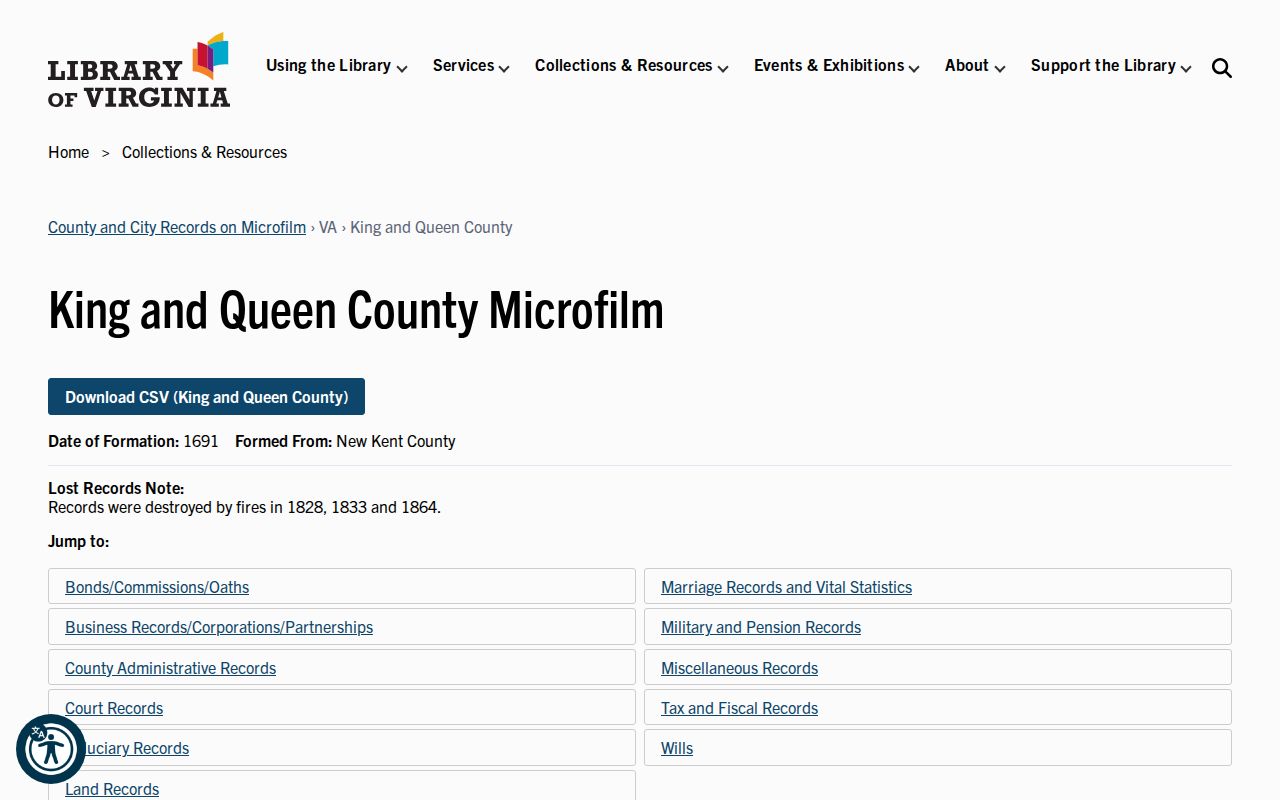
When a modern deed search stalls, the finding aid points researchers toward surviving volumes and microfilm.
Record Liens Alongside King and Queen Deeds
Deed research often goes beyond the deed itself. A King and Queen County parcel file may hold a deed of trust, a release, a judgment lien, a mechanic's lien, an easement, a restrictive covenant, or a lis pendens. Lis pendens simply means litigation is pending and could affect the parcel. Search related names and the full legal description. Then trace later satisfactions, releases, amendments, or court dispositions. A paid loan leaves a public trail until its release is recorded.
Business and secured-transaction filings live at the state level. The Virginia SCC lets UCC and federal tax-lien searches run by debtor name or file number, with PDF images for filings since October 1, 2003. A UCC record may involve fixtures or business collateral. It still cannot replace the county land-record title chain.
Virginia SCC UCC search guidance lays out the state filing route and image coverage.
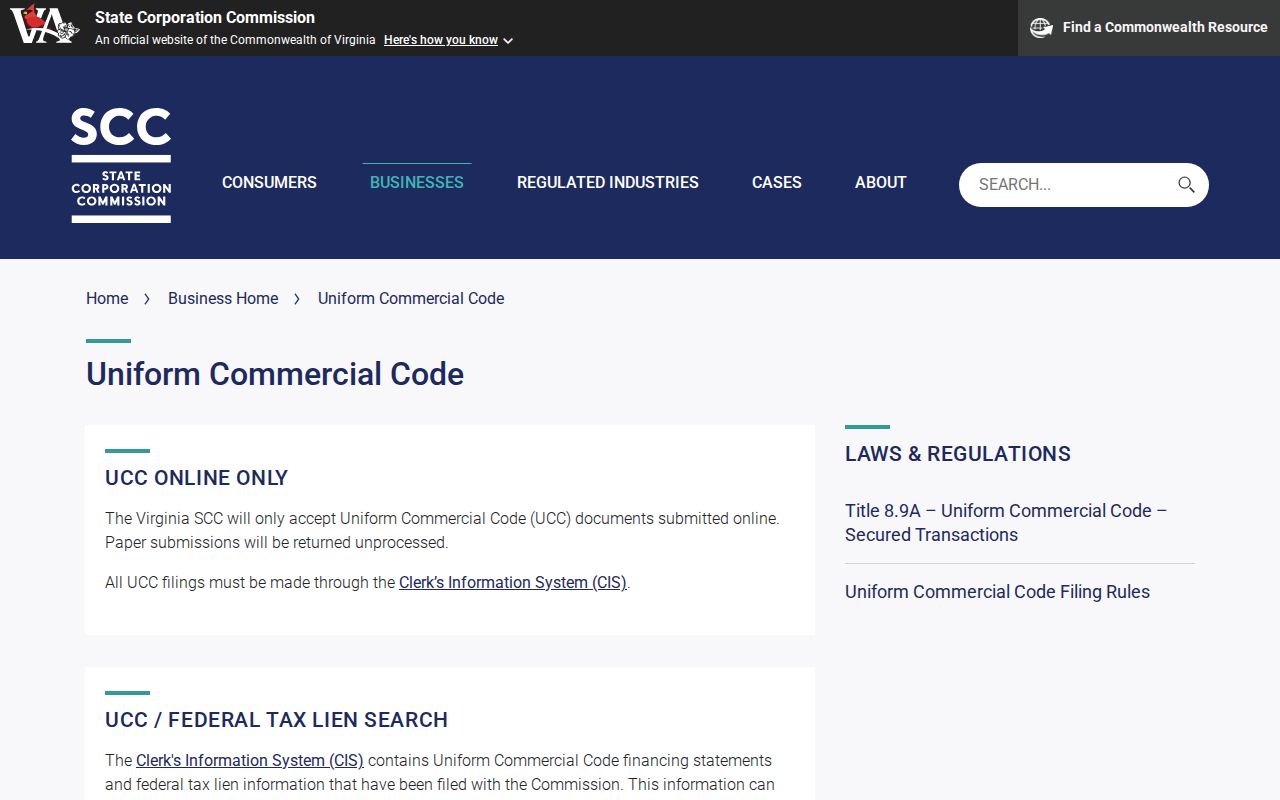
The state search can surface a secured-transaction clue. For deeds and land instruments, the county Clerk remains the source of record.
King and Queen Oyster Deed Records
King and Queen County's archive holds more than upland deeds. It includes oyster plats, oyster-ground records, and oyster inspectors' reports. These matter when a waterfront tract's history turns on water use or oyster grounds. They are not substitutes for a deed. A shoreline line on a modern map settles nothing about title to water or land.
Start with the ordinary deed description. Then check the Library catalog for the relevant oyster or plat volume. Ask the Clerk how surviving books can be inspected. A plat can reveal a lot layout, adjoining parcels, easements, or a road dedication. It may explain how a subdivision began. Yet only the deed shows what an individual instrument actually conveyed.
Request a King and Queen Deed Copy
The remote land-record system allows online inspection where a record is available. Otherwise, contact the Circuit Court Clerk about counter access and copying options. The county page documents public inspection and copying from the surviving period. It posts no current fee schedule for plain or certified deeds. Before paying or traveling, ask about format, certification, index year, and image access. Some records are not routine, and a public body may hold them. A Virginia FOIA request should name the record. It should also request an actual-cost estimate.
Recorded is not the same as clear title. A King and Queen County deed index locates what was recorded; it is not a title opinion, and it may not reveal every unrecorded interest. For a purchase or legal decision, have a qualified title professional examine the full chain, liens, easements, and estate transfers.