
King and Queen Property Search Steps
The Commissioner of the Revenue runs an e-Commissioner application with three entry modes. Use the situs address when it is current. Try an owner name when the address is missing. The GPIN or Tax Parcel ID is the strongest key once another record supplies it. The county's public landing page does not expose the interactive form labels. It also omits coverage years, result limits, and every card field. Each result deserves a second check.
Carry the parcel number from the assessment card into the Treasurer's real-estate inquiry. Then run it through the county GIS viewer. The county calls it a GPIN or Tax Parcel ID. Spaces must be typed correctly. For a legal ownership question, turn to the Circuit Clerk's grantor and grantee records. Search by the names and parcel references on the card. The order matters. It anchors a broad name search to a specific tract.
- Search the Commissioner’s card with the best address, owner name, or parcel number you have.
- Write down the returned GPIN, owner name, situs or mailing address, legal description, and any visible assessment year.
- Use the GPIN in the Treasurer inquiry and the GIS map, preserving the spaces shown on the bill.
- Search the Circuit Clerk’s land records by grantor and grantee, then compare the instrument image with the same parcel description.
- Ask the custodian about counter or mail access; for records of a public body, ask whether a Virginia FOIA request is the appropriate route.
King and Queen Property Search Keys
Address, owner, and GPIN are not interchangeable keys. King and Queen County's assessor landing page confirms each is a search mode, but it does not say which formats or partial matches the live form accepts. The Treasurer's help page is more precise. The street-name mode leaves out the house number, while an account or GPIN narrows the search to one tax record. Start broad only when you must. Then move to the exact parcel key.
| Search field | Type | Required | Documented use and limit |
|---|---|---|---|
| Owner Name, Commissioner | Text mode | Not stated | Owner-name search is advertised; test spelling and entity variants. |
| Parcel Number, Commissioner | Text mode | Not stated | Use the county parcel identifier; public format not stated. |
| Address, Commissioner | Text mode | Not stated | Search the situs address; rural road variants may matter. |
| Account Number, Treasurer | Text | Selected search mode | Number appears at the top left of the real-estate bill. |
| GPIN / Tax Parcel ID | Text | Selected search mode | Enter the spaces correctly as shown on the bill. |
| Street Name | Text | Selected search mode | Leave out the street number to see multiple matches. |
| Projected Date | Date or text | No | Optional estimate date for penalty and interest; otherwise current date applies. |
Commissioner Card Search in King and Queen
The Commissioner's property-card application is the first stop. It handles address, owner, and parcel searches. Its landing page says a card can return summary information, improvements, sketches, and photographs. That data appears when available. Availability is not guaranteed. The page lists no year range for historic card data. Treat the result as an assessment record. Note which fields actually appear on the parcel you opened.
Open the King and Queen County e-Commissioner property cards to choose your route. Pick the address, owner-name, or parcel-number option there.
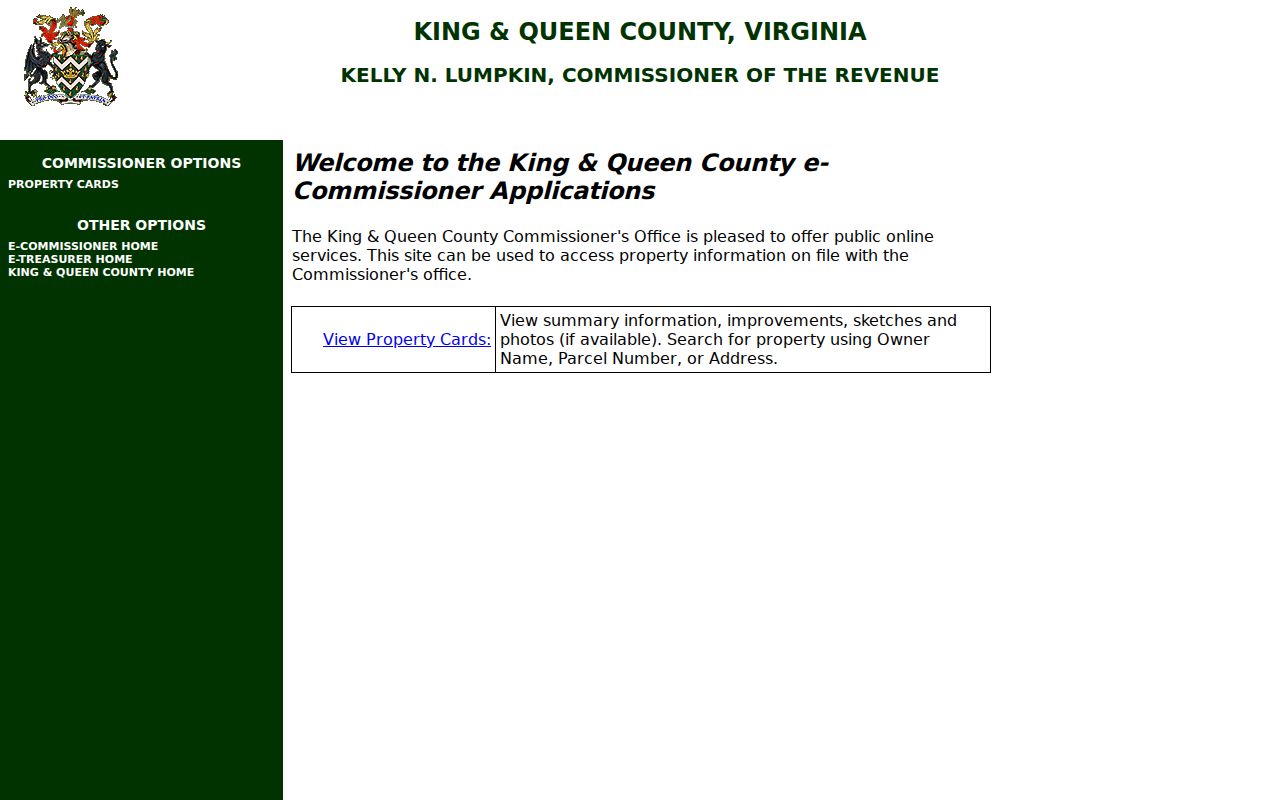
The view shows the entry point, not parcel results.
King and Queen Road Name Search
A King and Queen County property search can use the Treasurer's street-name method to find several accounts along a rural road. Enter the road name without the street number. Page through the matches if more than one screen appears. The result can toggle between a description and a map number, and opening a selection leads to payment history. A ticket link opens the detail view.
This route shines when an old property description gives a road but the present address is unclear. It returns tax inquiry matches only. The county documents no ZIP-code search. Confirm each candidate in the assessment card or map before carrying it to the deed index. A projected date is optional. It estimates penalty and interest as of that date.
The Treasurer's help page shows the account, GPIN, street-name, paging, and projected-date functions.
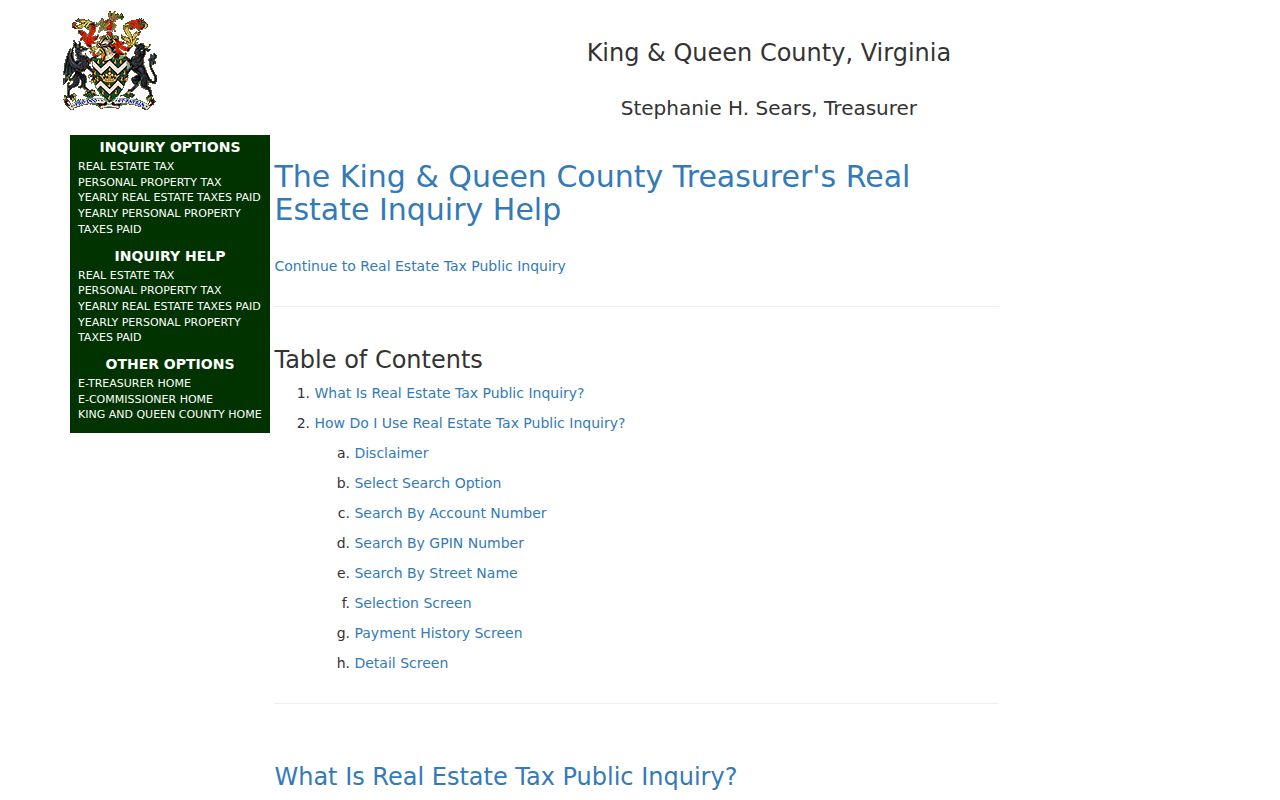
Use the fallback when a house number is uncertain.
King and Queen Property Search Results
The county describes property cards as summary records with improvements, sketches, and photographs when available. The static pages list no detailed card fields. Transcribe only what the result displays. A search screen is not a parcel record, and an advertised feature does not prove a given parcel includes it.
| Owner field | Record the exact visible label and name; the county landing page does not state the result label. |
|---|---|
| Situs and mailing address | Keep the physical parcel location separate from where tax notices are sent, if both are shown. |
| GPIN / Tax Parcel ID | Copy it exactly, including spaces, before moving to the Treasurer or map. |
| Assessment values | Note each visible land, improvement, total, or taxable figure and its year; the public page does not guarantee these fields. |
| Legal description | Use the recorded text to match the tract; rural descriptions may rely on metes and bounds or adjoining calls. |
| Sale reference | Capture date, consideration, and book/page only if the card actually displays them. |
Owner of record means the name in a county record. It may not cover every person who benefits from a trust, estate, or company. Situs is the physical location. The mailing address can sit elsewhere. A parcel ID joins office records. A legal description identifies the land in the conveyance. But neither is a title opinion, a survey, or an appraisal.
- GPIN
- The county’s parcel identifier, also called Tax Parcel ID in the Treasurer inquiry.
- Situs address
- The physical place where the property lies, distinct from the tax-mailing address.
- Owner of record
- The person or entity named in a record, which may lag a new deed or show a trustee or LLC.
- Legal description
- The deed’s written land description, such as metes and bounds or a platted lot reference.
King and Queen Owner Name Search
A name is often the only clue, since a relative's recollection or an old document may supply a person while saying nothing about an address. The Commissioner of the Revenue advertises Owner Name as a search option, which makes it a practical place to begin. Type the name exactly as the source gives it. If nothing appears, try again. Test a middle initial or a common spelling variant. Partial-match rules are unpublished. So are result limits. A blank result proves nothing about ownership.
Trusts, estates, and companies demand extra care. Use the exact entity wording from the latest deed, since similar names can belong to different people or businesses. A property card can lead to the parcel, and the Circuit Clerk's deed index establishes the recorded transfer. For a Virginia company, the SCC entity search may clarify its status and registered agent. That registry cannot connect the company to land on its own. Only the deed does that. Keep in mind that a tax mailing address may simply show where the bill goes rather than where the land sits.
Several tracts under one name call for comparison. Match the GPIN, legal description, and situs before choosing a result, and note how each match was verified so a similarly named owner or a neighboring parcel never becomes the wrong property in later research.
King and Queen GPIN Search
In King and Queen County, the GPIN or Tax Parcel ID is the strongest cross-reference once an office record supplies it. Copy every character exactly. The spaces count. The Treasurer's help material warns that a visually similar number, typed without the expected spacing, may fail to match. One key opens several doors. The county-linked GIS viewer accepts it too. It also ties to the tax inquiry.
The Treasurer's inquiry accepts an account number, GPIN, or street name, and results can be paged. The display toggles between description and map number, and a selected account opens payment history and ticket detail. Enter a projected date, and the inquiry calculates penalty and interest for it; leave the field blank and the current date applies. Real-estate taxes are due December 5. The office posts no account-fee schedule and no first year for the online archive.
The Treasurer's e-services page is the entry point for the tax account search.
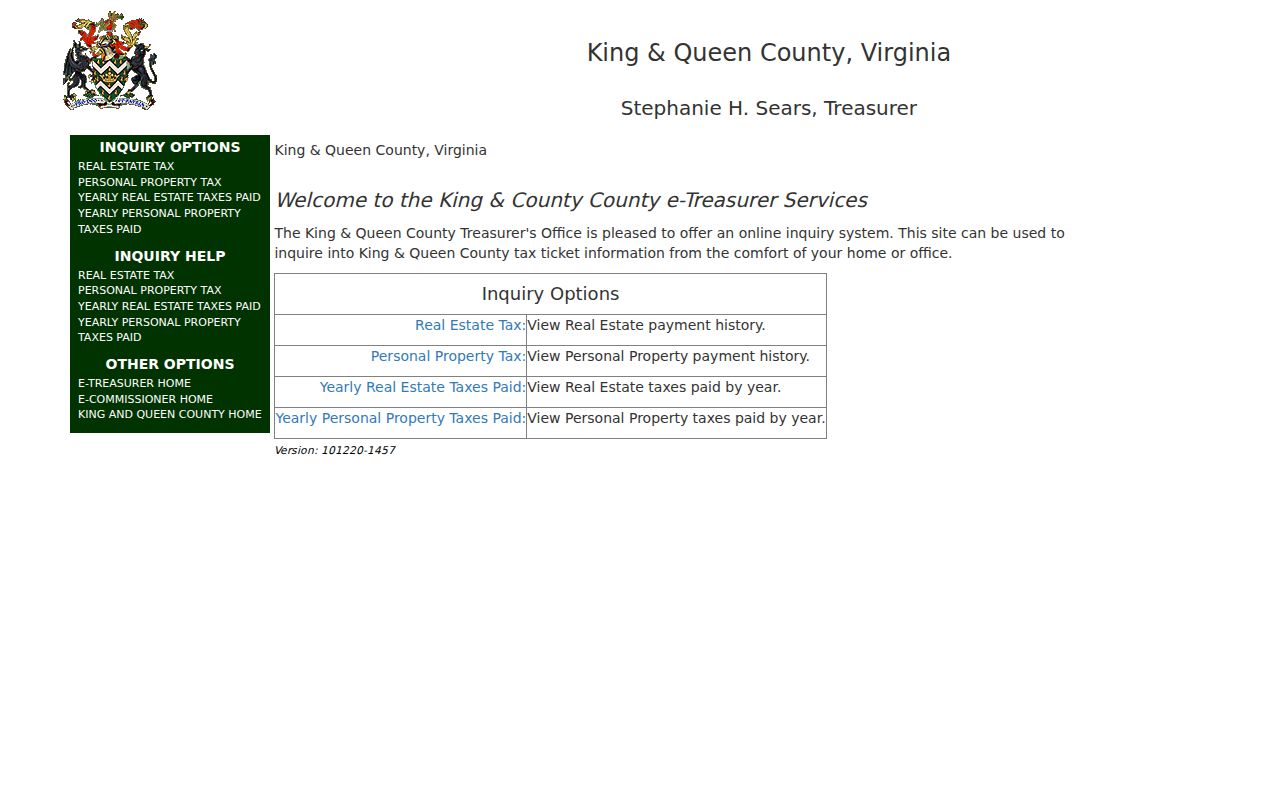
The Treasurer's online service page shows the route to the parcel and account inquiry. Confirm details in the live system.
King and Queen Property Search Offices
Sometimes no portal resolves the parcel, and a phone call or visit is faster. The Commissioner of the Revenue sits at 242 Allen's Circle, Suite I, P.O. Box 178. The listed numbers are (804) 785-5976 and (804) 769-5002. This office prepares the annual land book, fields assessment questions, and hands out tax-relief forms. Ask first which parcel key or year applies. That saves a correction or an older assessment record from going to the wrong file.
The Treasurer keeps payment history. Its real-estate inquiry remains the office's central tool. Deeds live with the Circuit Court Clerk. That office is at 234 Allen's Circle, P.O. Box 67, King and Queen Court House, VA 23085-0067, reachable at (804) 785-5984, with published hours of 8:30 a.m. to 4:30 p.m. Call before visiting. Confirm current access and fees for in-person deed inspection or copying, since no copy or certified-copy schedule is posted online.
Make each request specific. Name the record, parcel, and year rather than asking for a sweep of every system, so a property card never gets confused with a tax ticket, deed index, map, or permit file.
King and Queen Search by Address
An address in King and Queen County can be styled by highway, state route, river, or postal community, and that variety trips up searches. The county has no incorporated city, and places like Walkerton, Bruington, Mattaponi, Shacklefords, Stevensville, and King and Queen Court House do not form separate assessor districts. A failed address search is not the end. Test a road-name variant first. Then try the owner or parcel key. Verify postal ZIPs with USPS, since a mailing locality does not mark a county boundary.
| Search Key | Best For | Where It Works | Watch Out |
|---|---|---|---|
| Address | Locate one known property | Commissioner card; GIS | Postal place, old road name, or rural format may differ. |
| Owner name | Find parcels tied to a person or entity | Commissioner card; deed index | Initials, estates, trusts, LLCs, and same names need checking. |
| GPIN | Match the same tax parcel across offices | Commissioner; Treasurer; GIS | Spaces matter; old deeds may use a different identifier. |
Not a title search. A King and Queen County property search gathers record clues but does not establish clear title. Check the deed image, legal description, releases, and court or probate records, and use a title professional when the result will guide a purchase or legal decision.