
King and Queen Property Value Records
King and Queen County keeps assessment information and the Treasurer's tax account in separate hands. The Commissioner of the Revenue prepares the annual land book. The office assesses changes tied to new construction or improvements. The county's e-Commissioner application supports searches by owner name, parcel number, and address. A record there may show a summary, improvements, sketches, or photographs when available. What the public description does not spell out is just as important. It confirms no complete list of valuation fields. There is no stated assessment ratio. No countywide revaluation schedule appears either. Open the live parcel card. Ask the Commissioner about a specific field or year. Only then draw conclusions from King and Queen County property records.
| Value | What It Is | Where |
|---|---|---|
| Assessment record | County property card and annual land-book context; verify the displayed value and year | Commissioner of the Revenue |
| Improvements | Summary information and improvements; sketches or photos may be available | Commissioner e-Commissioner application |
| Recorded sale | Transfer instrument and sale-related details if recorded; not a new appraisal | Circuit Clerk deed records |
| Tax amount due | Account balance, payment history, and ticket details | Treasurer real-estate inquiry |
These numbers answer different questions, and mixing them causes trouble. An assessment is a tax-administration record. A deed documents a conveyance. A tax ticket shows an account amount owed to the county. The county pages publish no assessment-to-market ratio, no exact revaluation cycle, and no promise that a recent transaction has reached the card yet. Compare dates and source labels instead. Treating an assessment as a current sale price, or as a professional appraisal of a King and Queen County parcel, gets the question wrong from the start.
King and Queen Property Value Land Book
The Commissioner's annual land book is the backbone of property value research in King and Queen County. The office assesses changes for new construction and improvements. What it does not publish is a property-by-property valuation formula. It also omits a card refresh date. And it does not state the weight given to a recent sale. When comparing years, note the tax year. Note the exact value label too. Check whether an amount covers land, improvements, or the combined parcel. If a field is unclear, ask the Commissioner to explain it.
The Library of Virginia catalog and its preservation materials help with older land-book research. A 2023 preservation-award list includes King and Queen County Land Book 1904. That proves a preserved record series exists. It does not prove the volume is searchable online. Nor does it prove a modern assessed value can be rebuilt from it.
Open the county property-card application to look up a current parcel record.
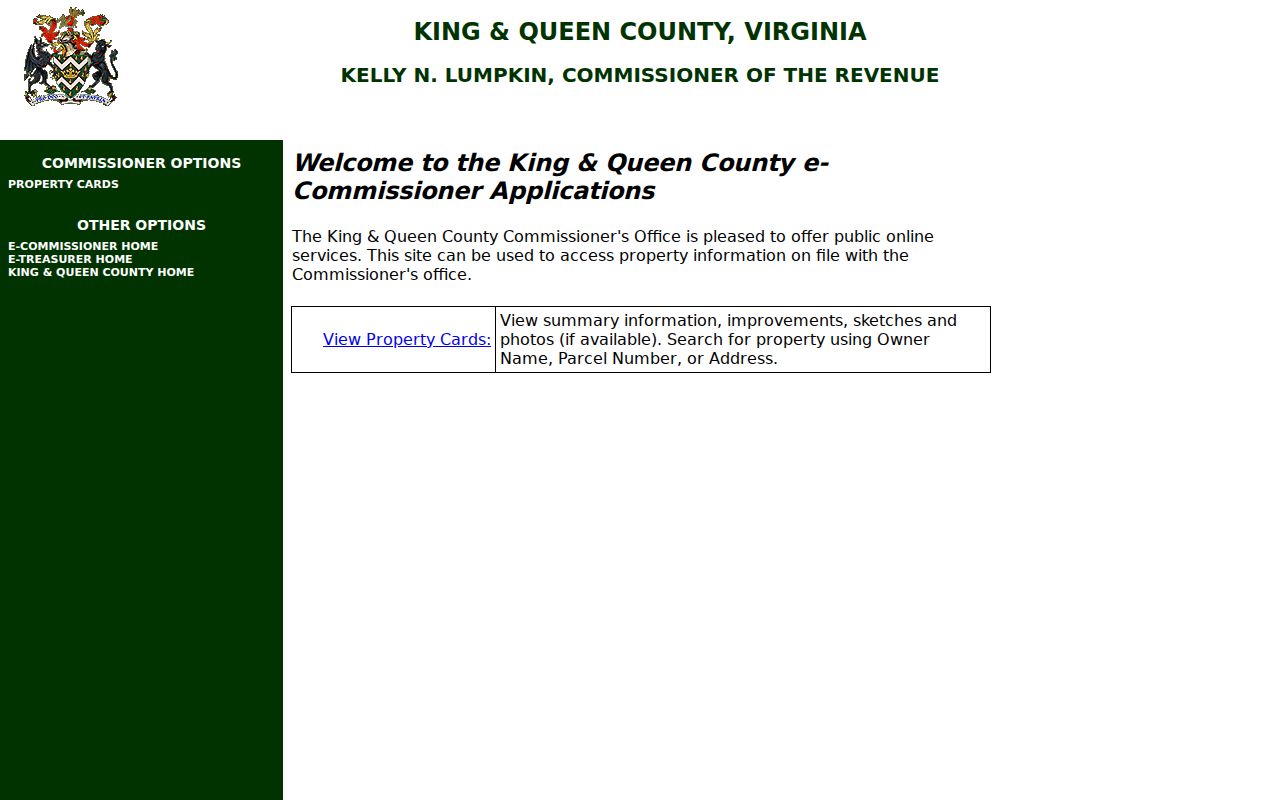
The county's property-card entry page shows where the search begins; confirm the live card's values and tax year directly.
King and Queen Property Value Improvements
Improvements explain many assessment changes in King and Queen County. The county says assessment records may include improvement information, with sketches and photographs when present. That detail can show why a property's assessment history moved. It helps explain changes after construction or a recorded improvement. Not every parcel has a sketch, a photo, or a full building history, though. The application's public landing page does not list every field. Rely on what the parcel record actually displays rather than filling gaps with assumptions.
When a value change tracks building work, Planning and Zoning or Building Inspection may hold a separate permit or plan file. Those files cover applications, inspections, and land-use review. They are not appraisal records. Ask with the parcel number and an approximate year. Keep a permit date separate from the date the assessment changed.
King and Queen Value Versus Sale
A recorded sale and an assessed value carry different dates and different purposes. To trace sale history, search the Circuit Clerk's land records by the parties or parcel reference. Then read the instrument itself. The Clerk reports that the surviving deed series begins in 1864. Older county deed evidence burned in fires in 1828, 1833, and 1864. A deed may identify a transfer and a legal description. It still does not turn the assessment card into a market appraisal.
Before comparing a recent sale with an assessment, confirm both records describe the same parcel. Check that they cover the same period. A parcel may have been divided, consolidated, or described differently over the years. For purchase, estate, or financing decisions, hire a licensed appraiser. The appraiser will assess market value for that purpose. The King and Queen County record alone is not a substitute for a professional appraisal of the property.
Look Up King and Queen Property Value
Start with the Commissioner application to pull the assessment card, then carry the GPIN or Tax Map/Parcel ID through every step so each result tracks the correct tract. The application handles owner-name, parcel-number, and address searches. Rural road names, route numbers, and mailing addresses rarely match the card's exact text, so an owner-name search or the parcel identifier is often the better second route. Preserve punctuation, initials, and spacing exactly as displayed. Verify the situs and legal description before comparing any amounts.
- Search the address, owner name, or parcel number in the Commissioner’s e-Commissioner property-card application.
- Confirm the location and parcel identifier; write down the value labels and year actually shown rather than assuming every card uses the same fields.
- For a transfer comparison, search the Circuit Clerk’s deed index and inspect the recorded instrument for the date and legal description.
- Use the Treasurer inquiry only when the question concerns a tax balance, ticket, or payment history, not an appraisal.
- Assessment record
- The Commissioner’s parcel and annual land-book information used in the county’s property assessment process.
- Market value
- An estimate of likely exchange value for a defined date and assumptions; the reviewed county pages do not identify a separate market-value field.
- Appraisal
- A professional opinion for a stated purpose and scope. A tax assessment card is not itself an appraisal report.
King and Queen Property Value Tax Relief
King and Queen County's Commissioner of the Revenue offers relief forms for two groups. One covers elderly or disabled real-estate tax relief. The other covers disabled-veteran relief on real estate and personal property. For the elderly or disabled real-estate application, April 1 is the published deadline. Eligibility rules, proof requirements, and appeal deadlines vary by situation. Ask the Commissioner before assuming a parcel qualifies.
Relief changes how an account is handled. It does not set a market price or revise the recorded deed. Keep the assessment card and relief decision separate from the Treasurer's tax bill and payment history is not required. Confirm which office owns your question before sending personal or financial records.
King and Queen Assessment History
The Commissioner prepares the annual land book each year. New construction and improvements show up there as changes. But the county publishes no uniform reassessment interval, assessment ratio, or promised update lag after a sale. Ask the office which assessment year the current card represents, and whether a listed change ties to a particular permit, correction, or review.
Historic land books add perspective across the years. The Library of Virginia's finding aid points to local deed books, indexes, plats, and land-book material. Access may mean a physical volume or microfilm. A dated historical assessment is evidence of the tax record at that point, not a present-day market estimate. The Treasurer's projected payment date feature, meanwhile, only calculates penalty and interest on an account, and has nothing to do with an assessed value date.
Comparing parcels takes care. Make sure the records describe similar land with the same value year and field. A parcel with more acreage, different improvements, or a separate tax identifier is not a direct match just because its road name is nearby. The county offers no public comparable-sales tool and no formula for adjusting values, so don't dress up a rough comparison as the Commissioner's methodology.
Limits of King and Queen Property Value
A county property value is only as precise as its source label. Its parcel match and year matter just as much. King and Queen publishes no complete card schema. It also offers no assessment methodology, ratio to market, or revaluation cycle. So never estimate missing fields. Never treat a value as current just because the page loads. Contact the Commissioner for the assessment record. Ask the Treasurer about a tax bill or payment history.
Assessment versus price. A King and Queen County assessment is a tax record, not a promise of what a property will sell for. For a transaction or another decision requiring market value, consult a qualified appraiser and review the parcel-specific deed and condition.