
King and Queen Tax Record Fields
King and Queen County property tax records live in two offices. Knowing which one does what saves time. The Commissioner of the Revenue assesses land and builds the annual land book. The Treasurer keeps the tax tickets, balances, and payment history. A smart search pairs the parcel number or GPIN with the street address. Keep in mind that a tax ticket is not a deed. A payment record never proves who owns the land. Use the right office for the question. Then confirm values, due dates, and appeal steps with the county itself.
| Field | What It Shows | Where |
|---|---|---|
| Land book and assessment | Annual property assessment; new construction and improvement changes | Commissioner of the Revenue |
| Property card | Summary, improvements, sketches, and photos when available | Commissioner e-Commissioner |
| Tax account | Account number, GPIN, description or map number, and ticket details | Treasurer inquiry |
| Payment history | Prior ticket payments and projected penalty or interest | Treasurer inquiry |
| Tax relief | Linked forms for elderly or disabled residents and disabled veterans | Commissioner of the Revenue |
An assessed amount is a local tax record. It is not a sale price and not an appraisal. King and Queen County publishes no ratio for converting an assessment into market value, so that math stays out of reach. A tax ticket answers a different question entirely. It shows the levy and whether it was paid. For what a property sold for, the deed and its recorded consideration are the land-record route. Keep those document types straight when comparing figures.
King and Queen Tax Bill Search
Begin with the real-estate account number or GPIN printed on the bill. That key opens the record fastest. Without it, search by street name alone, dropping the number, then page through the matches and compare the description or map number against the assessment card. Open the account to see payment history. From there, select the specific ticket for its detail. A projected date lets you calculate penalty and interest for any date you pick. Leave it blank and the current date applies.
- Choose the real-estate inquiry and search by account, GPIN, or street name.
- For street search, omit the street number and verify each result’s description or map number.
- Open payment history and the ticket detail for the account you have matched.
- Use the Commissioner’s card or office to check assessment and relief information separately.
- Land book
- The Commissioner’s annual local assessment record.
- GPIN
- The parcel identifier also called Tax Parcel ID in the Treasurer system.
- Tax ticket
- A bill or account detail that records a levy and its payment status.
- Tax relief
- A form-based reduction or exemption administered by the Commissioner, when approved.
King and Queen Tax Office Roles
For King and Queen County tax records, split the question first. The Commissioner holds the land book, the assessed parcel, and the tax-relief forms. The Treasurer holds the balance, the bill, and the payment history. The county's e-services landing page separates real-estate from personal-property inquiries. Pick real estate for land rather than trailing a vehicle account. The Commissioner's office sits at 242 Allen's Circle, Suite I. It lists (804) 785-5976 and (804) 769-5002. The two systems may share a parcel key. Neither replaces the other. A value question or relief application belongs to the Commissioner. A question about whether a ticket was paid belongs to the Treasurer. County material lists real-estate taxes as due December 5. The public pages post no copy fee. They post no payment convenience charge and no exact start date for online coverage. The Treasurer's e-services landing page lists the available tax inquiry routes.
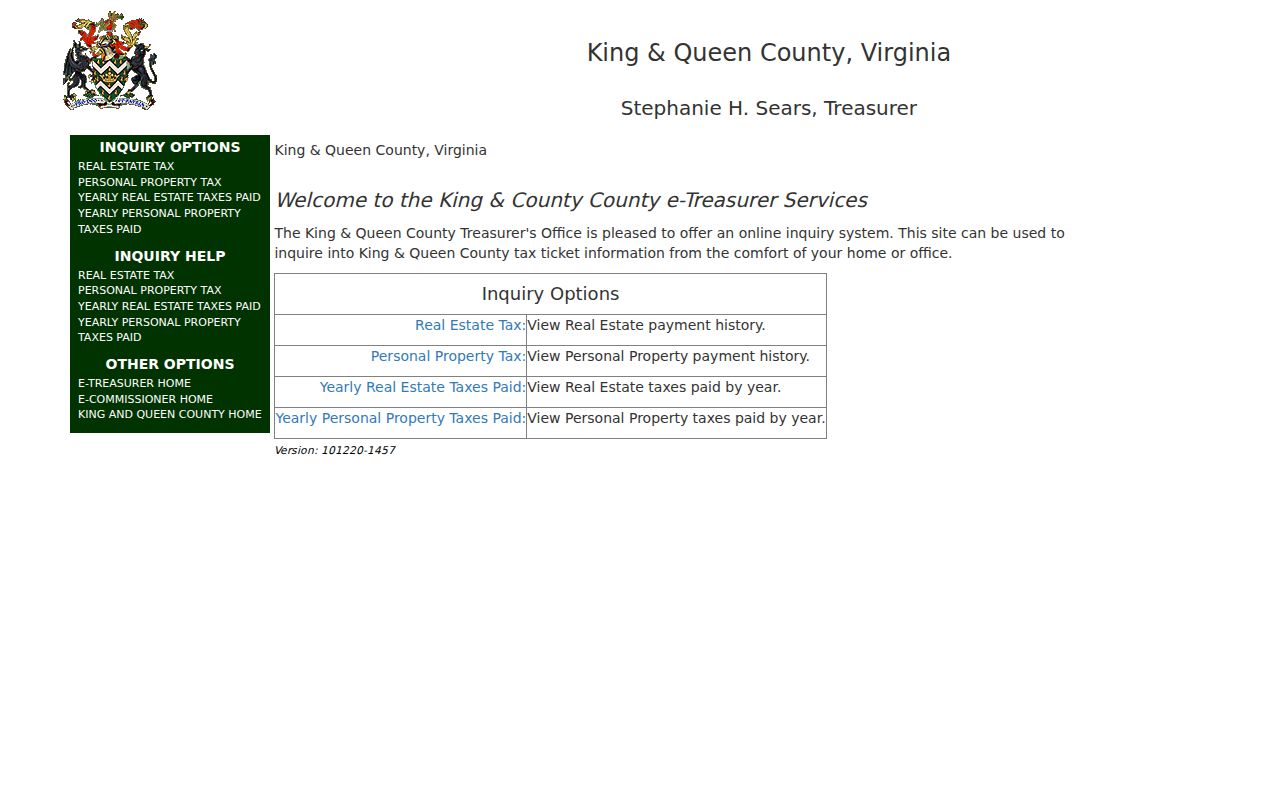
The menu distinguishes real-estate tax inquiry from other county payment records.
King and Queen Tax Search Keys
The Treasurer's help page documents three search keys. They are the account number, the GPIN or Tax Parcel ID, and the street name. The account number sits near the top left of a real-estate bill. The GPIN appears there too, and its spaces must be typed exactly right. The street-name option takes the road name without a street number. That can return several accounts on a rural road.
| Search choice | What to enter | What follows |
|---|---|---|
| Account number | Number printed on the real-estate bill | Select the account and open its payment history. |
| GPIN / Tax Parcel ID | Parcel ID with its spaces intact | Connect the ticket to the assessment card or GIS parcel. |
| Street name | Road name, without the house number | Review multiple descriptions and map numbers. |
| Projected date | Optional date | Estimate penalty and interest as of that date; blank uses today. |
Results can be paged and toggled between description and map-number views. Select a match to reach its payment history. Select a tax ticket for the finer detail. These controls make the Treasurer site handy for checking a block or comparing a bill. But every result still needs matching to the right parcel. Keep the real-estate account apart from other county payment records. Confirm the account's description before opening a ticket. When a street-name search returns several hits, compare the map number with the Commissioner card instead of grabbing the first match. A projected-date amount is only an estimate for the date entered. A blank date uses the system's current date. Verify the actual ticket and payment status with the Treasurer before treating any balance as final. The county pages post no earliest online year and no complete historic bill archive. They also post no direct phone number for the inquiry service. The real-estate inquiry instructions show the field names and result steps.
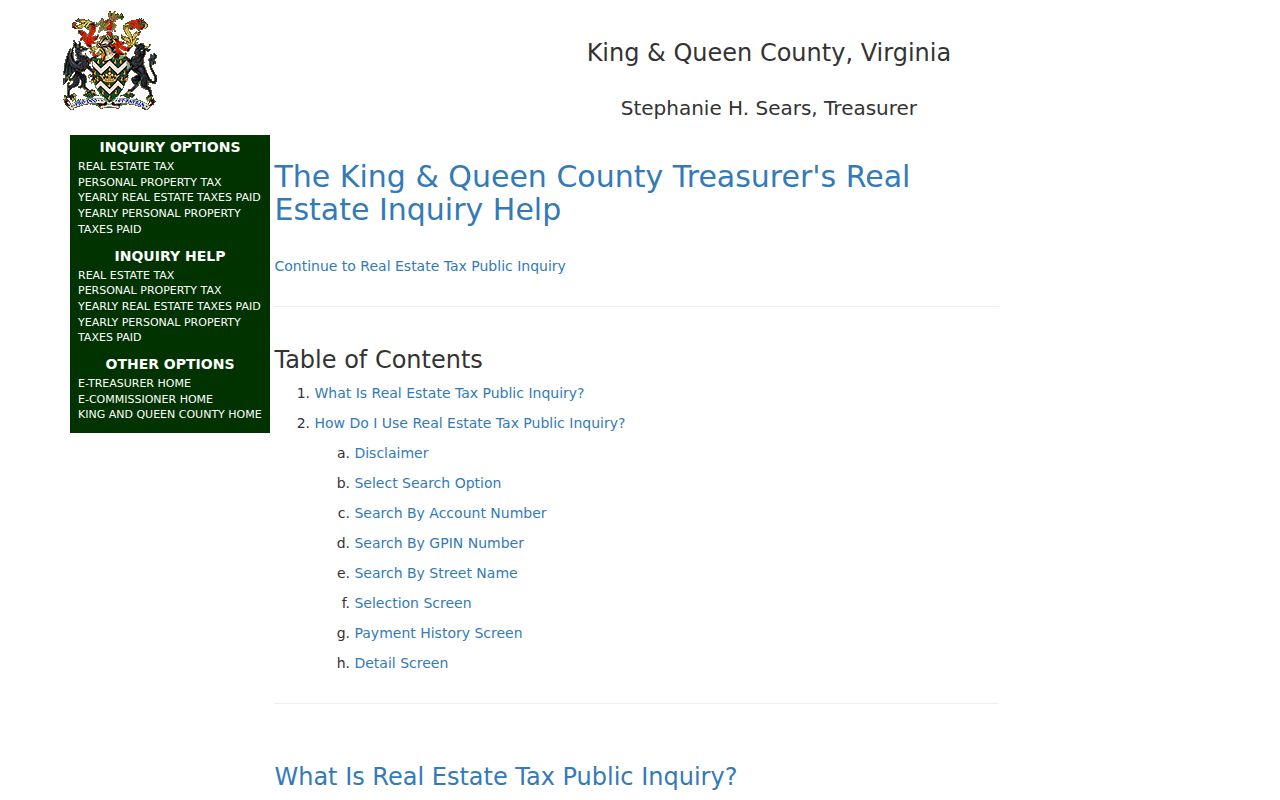
The help screen notes the street-number omission and the projected-date tool for the county inquiry.
King and Queen Tax Land Book Limits
The Commissioner prepares a land book each year. The office also assesses new construction and changes to improvements. The county advertises a public property-card search by owner name, parcel number, or address. Its landing page says a card may carry summary information. Improvements, sketches, and photos appear when available. The static material gives no exact year range. It lists no refresh timing after a sale, no value ratio, and no full assessment history. When checking a number, write down its label and year. Never assume it is market value or the amount currently due. The Treasurer ticket is where a bill and payment history get inspected. A tax record can trace the county's assessment and collection trail. It cannot surface every deed restriction, easement, or unrecorded interest. The Commissioner's property-card search is the public route for the assessment record.
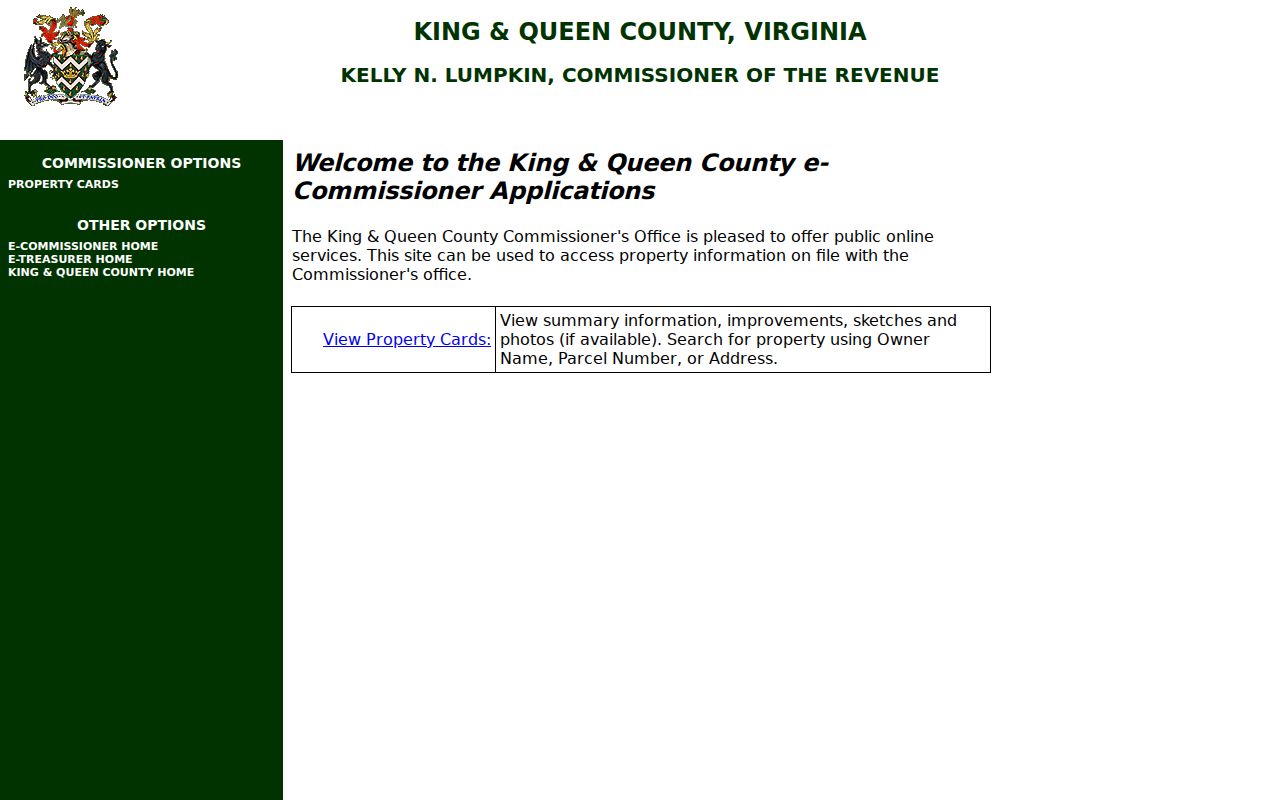
The entry screen offers three search modes, and each one reaches the same land-book cards. Parcel-specific fields appear only in a live result, so confirm them there before relying on a value.
King and Queen Tax Relief Forms
The Commissioner posts real-estate tax relief forms. Some serve elderly or disabled residents. Others serve disabled veterans. The county sets April 1 as the application date for the elderly or disabled exemption. A disabled-veteran exemption form is posted as well. The posted forms do not state income or asset limits. They also leave out proof rules, renewal steps, filing delivery, or a separate appeal calendar. Confirm those details on the current form or with the Commissioner. A form title alone never proves relief was approved on a parcel.
Check the account or card for the status the live record shows. Ask the office whether an application is pending. Personal-property exemptions are separate from the real-estate bill. This holds even when one county page links both form sets. The county property-information hub carries the current assessment and tax-relief routes.
King and Queen Delinquent Tax Limits
A balance on a tax ticket does not prove a foreclosure or tax sale is scheduled. The county publishes no delinquent-tax list, sale calendar, redemption rules, or complete procedure. Ask the Treasurer for the current delinquent real-estate steps. Then check Circuit Court dockets, courthouse postings, notices, and recorded instruments. Draw no conclusion about a parcel before that.
Tax-sale and foreclosure research may involve a notice, court case, commissioner's sale, trustee's deed, and a later release. Each piece has its own date and status. A payment history shows account activity. It does not by itself prove a transfer. For a legal or purchase decision, confirm the final order and recorded instrument. Do this with the custodian and a title professional.
For King and Queen County, start by asking the Treasurer about the delinquent account. Ask whether any public notice applies. Next, check the Circuit Clerk's recorded land documents. Check the court's case information when a proceeding is reported. The county offers no public tax-sale roster or online auction calendar. Do not treat an unpaid ticket, a third-party list, or a projected penalty amount as proof of a scheduled sale.
King and Queen Assessment Appeal Steps
King and Queen County names the Commissioner as the local assessing officer. The county's pages link the tax-relief forms. The county posts no current real-estate assessment appeal board, filing deadline, hearing steps, or appeal form online. Never use a zoning appeal date as an assessment deadline. Contact the Commissioner with your questions. Ask which review process applies. Ask what evidence is accepted. Ask whether a deadline follows the assessment notice or another event.
When preparing a question, gather the parcel ID, assessment year, and field label. Keep the reason for disagreement with them. Comparable assessments, property characteristics, a corrected description, or documented changes can help explain the issue. The county's actual procedure controls, though. Keep a request for correction separate from an application for tax relief. Those are distinct actions with distinct forms.
Verify the appeal window. The inspected county material does not publish an assessment-appeal deadline or board procedure. Ask the Commissioner for the current notice, form, delivery method, and filing date before relying on a calendar or a third-party summary.