
King and Queen Current Owner Record
The Commissioner of the Revenue keeps the county land book and a public property-card application. That portal lets you search by owner name, parcel number, or address, and a result can include summary information, improvements, sketches, and photos. What the county does not spell out is the exact owner-field label, whether every card shows a mailing address, or how fast a new transfer reaches the assessment record. Read the live card. Treat no expected field as guaranteed.
| Owner field | Capture the exact name and label shown; the static county page does not confirm the result label. |
|---|---|
| Mailing address | Record separately if displayed; it may differ from the parcel location. |
| Situs or property address | Use the physical location to match the card to GIS and permit records. |
| GPIN / Tax Parcel ID | Copy the parcel key with spaces intact for the Treasurer inquiry. |
| Deed reference | Use a book/page or instrument number only if the card shows one; confirm in the Clerk index. |
| Sale or assessment date | Note the date and field label if present; public text does not guarantee either field. |
An owner of record is simply the name on a public entry. It does not tell you who lives there or who controls a company or trust. Situs is the physical parcel location. A mailing address is where a tax notice may go, and it could be a post office box, a trustee, a business, or an out-of-county address. Use the two fields to reconcile property records rather than to infer where someone resides.
King and Queen Current Owner Fields
The county card application offers owner name as a search mode. But the county publishes no sample result card. So the live record might label its field owner, taxpayer, or something else. Pull the exact label, parcel ID, assessment year, and legal description straight from the live record. Never report a missing field as though the site had shown it.
The Commissioner prepares the annual land book and assesses new construction and improvements. The county states no typical lag between a closing and a card update. So a newly sold parcel still needs a deed check. A card name is a strong present-day lead. The latest recorded deed remains the stronger source for the transfer date and grantee.
The county's property-card application is the official public search route.
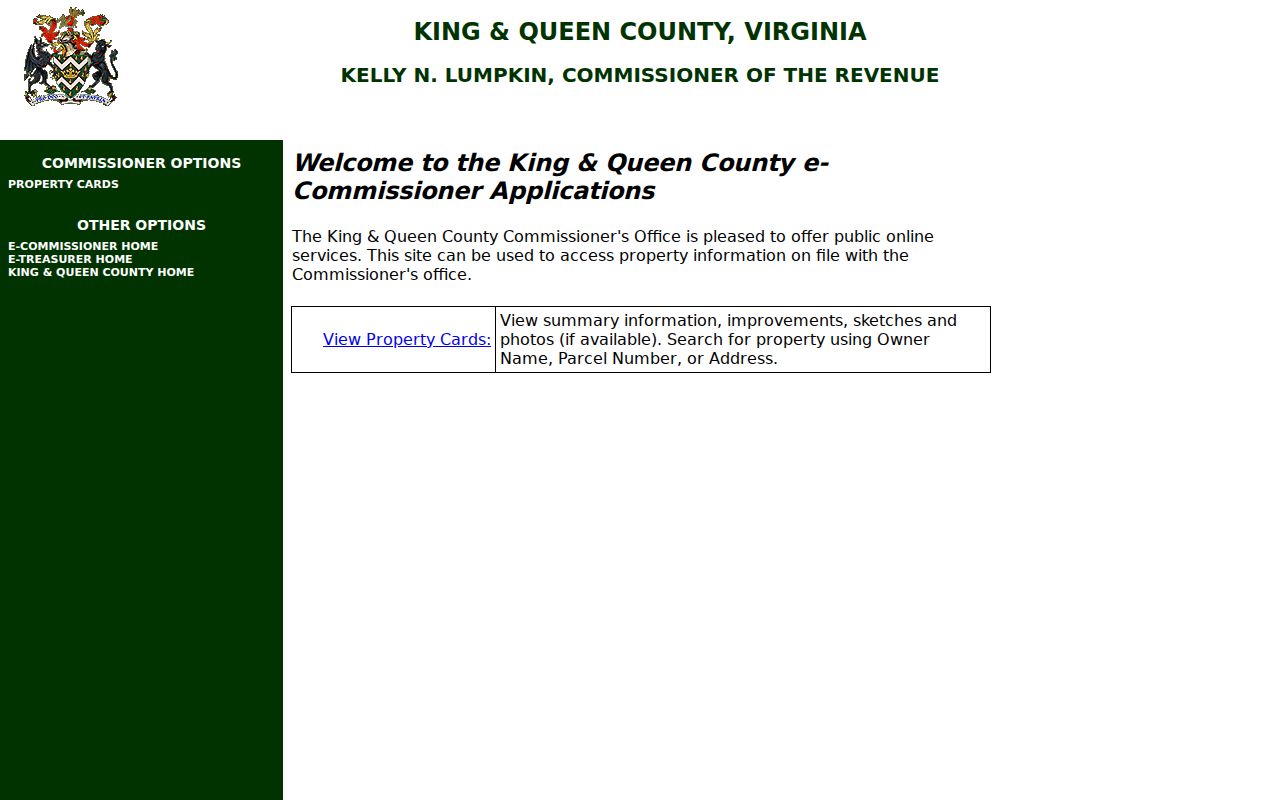
The official application page shows the search screen where a name lookup begins. It is not a sample owner card, so its full field set appears only in live results.
King and Queen Current Owner Deed Check
Take the name from the assessment card into the Circuit Clerk's grantor and grantee records. A grantee receives an interest. A grantor conveys it. Open the instrument image when available. Compare its recording date, parcel reference, and legal description with the card. A deed of trust is not a purchase deed. A release or satisfaction conveys nothing. The instrument type determines what the record actually says.
The clerk reports land records surviving from 1864 forward, open for inspection and copying. Fires in 1828, 1833, and 1864 destroyed earlier county records. The county's age does not guarantee a deed for every year. A chain can still hit gaps. Wills, fiduciary records, court orders, and Library of Virginia indexes work as collateral evidence. They are not an assumed transfer.
Remote land-record access runs through Virginia SRA by subscription. The courthouse counter is the other route. The clerk posts no current image or certified-copy fees on those pages.
Confirm the King and Queen Current Owner
To confirm the current owner, set the assessment card beside the most recent conveyance accepted for recording. The card links the parcel to a name. The deed identifies the grantee and the land description. The county states no assessor refresh interval, so after a recent sale the deed date can be newer than the card. Do not guess at the lag. Check both records, and ask the Commissioner whether a card update is still pending.
- Open the Commissioner card and record the visible owner name, parcel ID, and situs details.
- Search the Circuit Clerk land records for the latest conveyance under the owner or prior grantor name.
- Compare the grantee, recording date, legal description, and parcel reference in the instrument image.
- If the grantee is an entity or estate, review the recorded authority and related public filings without assuming a hidden individual owner.
- Owner of record
- The name shown in a public assessment or conveyance record.
- Grantee
- The person or entity named as receiving the deed interest.
- Vesting
- The way the deed states title is held, including an individual, joint parties, trust, or entity.
- Recording lag
- The gap between a transfer and its appearance in another system; the county’s typical interval is not published.
King and Queen Current Owner Timing
The Commissioner confirms annual land-book preparation. But the county publishes no refresh interval after a sale. It also gives no normal gap between closing and an updated owner entry. A recent deed can therefore be newer than the assessment card. Compare recording dates and the grantee before calling a tax-roll name the latest recorded owner.
Never use a tax ticket to settle a transfer question. The Treasurer system shows account, GPIN, payment history, and ticket detail. The Circuit Clerk holds the recorded conveyance. A payment by one person does not make that person the owner. And an unpaid bill does not prove a foreclosure.
When records seem out of step, compare their dates. Do not pick one name by appearance. The deed's recording date documents the filing in the land records. The card belongs to the annual assessment system. The Treasurer ticket concerns only a tax account. Ask the Commissioner whether a card update is pending. Also ask the Clerk for the instrument that controls the recorded transfer. Keep the GPIN and legal description with the answer. Then a later property search can reproduce the match.
King and Queen Current Owner Entity Names
A current-owner search in King and Queen County sometimes lands on a company, a trustee, an estate, or several grantees. That happens instead of one person. When that happens, keep the deed's exact vesting language and its instrument date. Those details anchor whatever you find. If the owner of record turns out to be a Virginia business entity, the State Corporation Commission's CIS can supply its status, registered agent, principal office, and filings where available. That information helps you read the entity name correctly. But it cannot prove which individual stands behind a particular tract. The only sound link between the entity and the land is the recorded deed. A comparable instrument in the county's deed records works too.
Watch for false matches. Company names that look alike, an entity that has renamed itself, or an inactive status can all point you to the wrong record. Compare the exact legal name and the filing history before drawing any conclusion. If the assessment card and the deed seem to disagree, ask the Circuit Clerk. The Clerk can say which land record holds the latest conveyance. Never infer a private beneficiary from an agent's name or a mailing address. Virginia SCC CIS is the state's official business entity search for this kind of check.
King and Queen Current Owner Alerts
The Clerk's office promotes Virginia's free, voluntary VADeed Alert service. It matches an owner name or a Tax Map/Parcel ID. It then sends notice when something is recorded against it in the county deed records. For a current owner, that early word can matter. Still, limits apply. An alert does not stop a deed from being recorded. It also does not certify that a filing is valid. When a notice looks unfamiliar, review the instrument itself. Call the Clerk through an official number.
Matching depends entirely on the name or parcel key entered. An entity name, an older parcel number, or a spelling variant may not match the way you expect. A notice can slip by. Treat any alert as a prompt to verify the public record. It is not a final decision on ownership. The Virginia VADeed Alert portal provides the current sign-in and enrollment route.
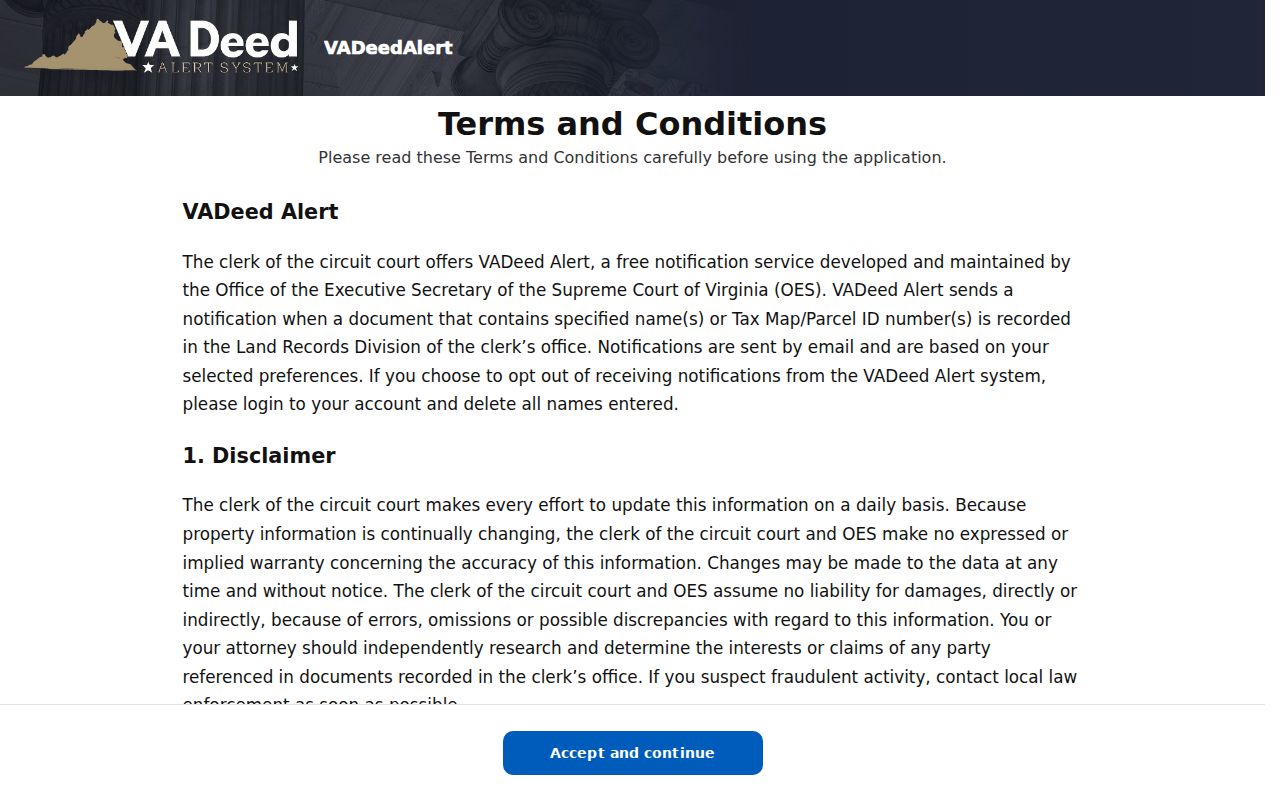
Note: The alert screen displays a monitoring service, not proof that the assessment card or deed is current.
King and Queen Owner Address Limits
A mailing address on a King and Queen County parcel record has narrow uses. It can separate two owners with similar names. It can also show where a tax bill or tax roll notice goes. It is not proof that anyone lives there. And it is never an invitation for unwanted contact. Public property records hold historical addresses as well as current ones. So use only what you need to verify the parcel and its recorded transfer, and resist guessing where a person actually resides from scattered references.
Lawful use. Use King and Queen County current-owner records for property diligence and record verification. Do not use a name or mailing address to stalk, threaten, or harass anyone.